
Higgsy's Handy Hints
14 min read

Legal Tech ROI: What’s Worth the Investment in 2026? 

Overview

Helping law firms invest smarter in technology that delivers measurable value 

In 2026, legal technology is no longer a “future initiative”, it’s part of the competitive foundation of modern legal practice. The conversation has shifted from “Should we invest in legal tech?” to a more important question: “Where will we get the greatest return?”.

For many UK law firms, particularly in the mid-market, technology budgets remain under pressure. Inflation, recruitment costs, compliance demands, and client pricing sensitivity mean firms can’t afford expensive systems that fail to deliver adoption or measurable outcomes.

At the same time, clients expect faster responses, more transparency, better collaboration, and increasingly digital experiences. Firms are being asked to do more with less, and technology is central to achieving that balance.

But not every legal tech investment produces the same return. Some systems reduce administrative overhead dramatically. Others improve client retention or unlock scalable growth. And some, despite impressive demos, simply add complexity without solving a real operational problem.

So, where should firms invest? How can leadership teams evaluate ROI beyond the marketing hype?

The New Definition of ROI in Legal Tech 

Historically, law firms measured technology ROI narrowly. Did it reduce costs? Did it save time? Did it improve billing efficiency? 

Those metrics still matter, but now the definition of ROI is broader. Modern legal tech investments are increasingly judged on: 

  • Client experience 
  • Lawyer productivity 
  • Retention and recruitment 
  • Risk reduction 
  • Operational scalability 
  • Data visibility 
  • Competitive differentiation

The reality is that some returns are financial, while others are strategic. The smartest firms are evaluating legal tech not as isolated software purchases, but as enablers of better service delivery and sustainable growth. 

A client portal may not immediately increase revenue. However if it improves client satisfaction and retention, its long-term value may exceed a purely administrative system. 

Practice & Case Management Systems: Still the Highest-Impact Investment 

Despite the excitement surrounding AI, many firms still operate on ageing practice management systems that create friction across the business. Upgrading core PMS infrastructure remains one of the highest-ROI investments available. Why? Because the practice management system touches almost everything:

  • Matter workflows 
  • Billing 
  • Time recording 
  • Document handling 
  • Reporting 
  • Compliance 
  • Client communication 

An outdated PMS creates inefficiencies everywhere. Common warning signs include: 

  • Double data entry 
  • Excessive manual workflows 
  • Poor reporting visibility 
  • Slow onboarding 
  • Disconnected systems 
  • Heavy reliance on email 

Modern cloud-based platforms offer: 

  • Workflow automation 
  • Better integrations 
  • Mobile accessibility 
  • Real-time dashboards 
  • Improved compliance tracking 
  • Enhanced user experience 

Where firms see measurable returns: 

  • Reduced admin time 
  • Faster billing cycles 
  • Improved cash collection 
  • Better management reporting 
  • Lower IT maintenance costs 
  • Reduced operational risk 

For firms still operating legacy systems, this is frequently the most commercially impactful upgrade available. 

The ROI often comes not from one dramatic improvement. Often it comes from hundreds of small efficiencies gained daily across the firm. 

Client Portals & Self-Service Platforms: The Rising ROI Leader 

Client expectations have changed permanently. Clients now compare their legal experience not just with other law firms, but with their experiences in online banking, Amazon Tracking, healthcare portals and modern SaaS platforms. 

They expect visibility, convenience, and responsiveness. This is why client portals are rapidly becoming one of the strongest ROI investments in legal technology. 

Done well, client portals create benefits on both sides of the relationship. 

For clients:

  • 24/7 matter visibility 
  • Secure document access 
  • Faster communication 
  • Easier onboarding 
  • Greater confidence and transparency 

For firms:

  • Reduced inbound email traffic 
  • Fewer administrative queries 
  • Improved client satisfaction 
  • Better document control 
  • Stronger differentiation 

Many firms underestimate how much client experience influences buying decisions. In competitive markets, convenience increasingly matters almost as much as expertise.

The hidden ROI is particularly powerful. Better retention, more referrals, higher perceived professionalism, improved client trust.

AI Tools: High Potential, but ROI Depends on Use Case 

Artificial intelligence dominates legal tech conversations in 2026, but it’s also where firms risk wasting money if investments lack focus. The biggest mistake firms make is buying AI tools before identifying specific operational problems. AI delivers strongest ROI when applied to: 

  • Document summarisation 
  • Contract review 
  • Legal research acceleration 
  • Internal knowledge retrieval 
  • Drafting assistance 
  • Compliance monitoring 

AI absolutely matters in 2026, but disciplined implementation matters more. 

The key is practicality. Firms seeing genuine returns typically: 

  • Start with narrow use cases 
  • Pilot internally 
  • Measure outcomes carefully 
  • Maintain human oversight 

Where ROI becomes difficult is when firms attempt large-scale AI transformation without workflow alignment or cultural adoption. Technology alone rarely changes behaviour. The most successful firms treat AI as a workflow enhancement, not a workforce replacement. 

Strong ROI indicators for AI: 

  • Time saved on repetitive tasks 
  • Faster document turnaround 
  • Reduced junior admin burden 
  • Improved knowledge access 
  • Increased fee-earner capacity 

Weak ROI indicators: 

  • “Innovation theatre” 
  • Unused AI subscriptions 
  • Overlapping tools 
  • Poor governance 
  • No measurable KPIs 

The AI Revolution in Legal Services: Beyond the Hype and into Practical Applications 

Artificial Intelligence (AI) has dominated the headlines in the past two years, with breathless claims about how it will “replace lawyers” or “redefine justice.” In reality, the truth is both more nuanced and more interesting. While AI won’t be putting solicitors out of work any time soon, it is reshaping legal services in very practical ways — particularly in the UK’s mid-market, where firms are seeking to balance efficiency, compliance, and client expectations with limited resources.

Document Automation: Quietly One of the Best Investments 

Document automation rarely gets the same attention as AI, but it consistently delivers some of the clearest and fastest ROI in legal tech. Why? Because law firms generate enormous volumes of repeatable documentation: 

  • Engagement letters 
  • NDAs 
  • Employment contracts 
  • Standard agreements 
  • Compliance forms 
  • Property documents 

Automating these workflows reduces drafting time, human error, version inconsistency and administrative workload. It also improves profitability on fixed-fee work. 

For many firms, document automation becomes the bridge between traditional workflows and broader AI adoption. And unlike some emerging technologies, its ROI is usually straightforward to measure. 

Business Intelligence & Reporting Tools: The Overlooked Growth Engine 

Many law firms still struggle with fragmented reporting. Leadership teams often lack real-time visibility into: 

  • Profitability by matter type 
  • Team performance 
  • Work-in-progress trends 
  • Client acquisition costs 
  • Utilisation rates 
  • Cash flow forecasting 

This lack of real-time visibility creates reactive management instead of proactive strategy. Modern Business Intelligence tools allow firms to:

  • Identify profitable work types 
  • Spot bottlenecks early 
  • Improve forecasting 
  • Monitor operational KPIs 
  • Make faster strategic decisions 

The ROI here is less operational and more strategic: better decisions, faster. In 2026, firms that effectively use data consistently outperform firms relying on instinct alone. 

Cybersecurity & Compliance Technology: ROI Through Risk Reduction 

Cybersecurity is sometimes viewed as a cost centre because its ROI is preventative rather than visible. But legal firms remain prime targets for cybercrime due to: 

  • Sensitive client data 
  • Financial transactions 
  • Property work 
  • Corporate information 

A serious breach can damage: 

  • Reputation 
  • Client trust 
  • Regulatory standing 
  • Financial performance 

Investments in: 

  • Multi-factor authentication 
  • Secure client communication 
  • Threat monitoring 
  • Compliance automation 
  • Access controls 

may not generate visible revenue, but they protect the firm from catastrophic downside risk. That protection itself is ROI. 

So Where Should Firms Prioritise Investment? 

The answer depends on firm maturity. 

If your infrastructure is outdated, start with: 

  • Practice management 
  • Workflow automation 
  • Core integrations 

If operations are stable but client experience is weak, prioritise: 

  • Client portals 
  • Self-service tools 
  • Communication platforms 

If efficiency is the primary challenge, focus on: 

  • Document automation 
  • AI-assisted workflows 
  • Knowledge management 

If leadership lacks visibility, invest in: 

  • Reporting 
  • BI dashboards 
  • Financial analytics 

The key is sequencing. High-performing firms avoid buying disconnected “point solutions” without a wider strategy. Instead, they build ecosystems where technology works together. 

The Real ROI Question: Adoption 

The uncomfortable truth is this, even excellent technology delivers poor ROI if nobody uses it properly. In many firms, the biggest barrier isn’t software quality, it’s adoption. Common problems include:

  • Poor training 
  • Weak leadership buy-in 
  • Change fatigue 
  • Lack of workflow alignment 
  • Insufficient communication 
  • No measurable success criteria 

This is why change management matters as much as technology selection. The firms getting strongest ROI are not necessarily buying the most advanced tools. They’re the firms: 

  • Implementing carefully 
  • Communicating clearly 
  • Measuring consistently 
  • Building user confidence 
  • Improving gradually 

Technology succeeds when people trust it. 
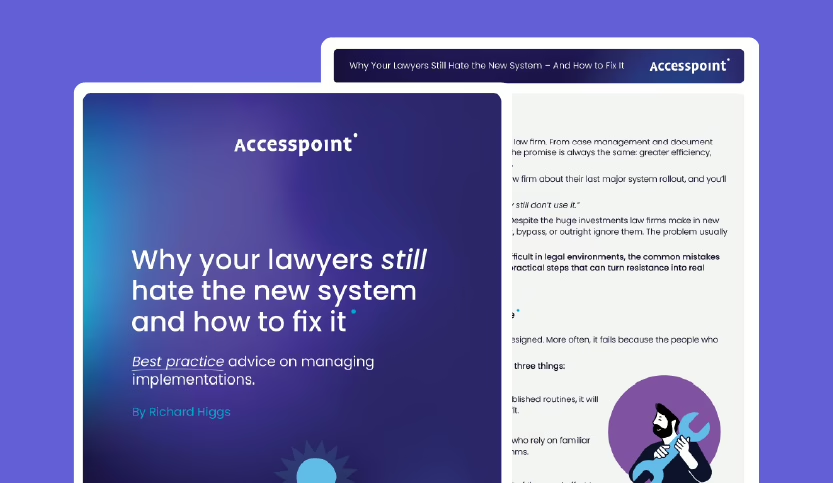
Why your lawyers still hate the new system and how to fix it

Technology is central to modern law firms, promising greater efficiency, smoother workflows and better client service. Yet many lawyers resist, bypass or ignore new systems despite significant investment. The problem is rarely the software itself. This e-book explores why technology adoption is challenging, common mistakes firms make, and practical ways to turn resistance into engagement.

Conclusion: Invest strategically, not emotionally 

Legal tech in 2026 offers enormous opportunity, but only when investments are tied to genuine business outcomes. The firms seeing strongest returns are focusing less on hype and more on: 

  • Client experience 
  • Operational efficiency 
  • Workflow simplification 
  • Data visibility 
  • Strategic scalability 

Not every investment needs to be revolutionary. Sometimes the highest ROI comes from removing friction, improving communication, or saving lawyers an hour a day. Ultimately, the most successful firms will be those that stop asking: “What’s the newest technology?” and start asking: “What problem are we trying to solve?”.

Because in legal technology, the smartest investment is rarely the flashiest one, it’s the one your people will actually use, your clients will genuinely value, and your business can scale around. 

Need help identifying where your firm’s IT investment priorities should be right now?

Here at Accesspoint, we listen first and then we advise. With deep industry knowledge and practical experience across a broad portfolio of proven law firm-focused applications, implementation services, and specialised supplier partners, we can help guide your firm through the noise and on to enjoying real world ROI from your technology investments. Contact us today for a friendly, initial chat with the one of our experts.

Contact Higgsy today

If you want to chat about anything in this blog or you want to discuss IT systems integration, how we can leverage AI to enhance your law firm and how Accesspoint can help, then email me today.


Law Firm SEO
10 min read

What is E-E-A-T? A Simple Guide to Creating Better Content

Overview

What is E-E-A-T? A Simple Guide to Creating Better Content

If you’ve spent any time reading about SEO, you’ve probably come across the term E-E-A-T. It sounds technical, but the concept is actually quite simple.

E-E-A-T stands for:

  • Experience
  • Expertise
  • Authoritativeness
  • Trustworthiness

These are the quality signals that Google uses when assessing whether content is helpful, reliable, and worthy of ranking in search results.

While E-E-A-T is not a direct ranking factor in the same way as page speed or keywords, it plays an important role in how Google evaluates content quality. The stronger your E-E-A-T signals, the more likely your content is to be viewed as credible and useful.

Achieving strong E-E-A-T signals often requires a strategic SEO approach, particularly in competitive sectors such as law. While an SEO specialist can help ensure your website demonstrates expertise, authority and trust effectively, there are still some simple improvements that anyone can make to enhance their content.

Why Does E-E-A-T Matter?

Google’s goal is simple: provide users with the most accurate and helpful information possible.

Imagine you’re searching for information about:

  • A medical condition
  • A legal dispute
  • Financial advice
  • Home-buying guidance

Would you trust advice from an anonymous website with no evidence of expertise, or from a qualified professional with real-world experience?

Google asks the same question.

This is especially important for what Google calls “Your Money or Your Life” (YMYL) topics, such as law, finance, health, and safety, where inaccurate information could have serious consequences.

For law firms, demonstrating strong E-E-A-T is particularly important because potential clients are looking for trustworthy legal guidance.

Breaking Down the Four Elements of E-E-A-T

Experience

What is Experience in E-E-A-T? Experience refers to first-hand knowledge of a subject.

For example, a solicitor writing about handling a divorce case can draw on real experience gained through working with clients. Likewise, someone sharing their experience of navigating the family court system can demonstrate practical insight.

To improve experience signals:

  • Share real examples and case studies.
  • Include practical observations where appropriate.
  • Explain common challenges people face.
  • Use examples that demonstrate genuine familiarity with the topic.

Expertise

What is Expertise in E-E-A-T? Expertise relates to knowledge and qualifications.

For legal content, this might include:

  • Solicitor qualifications
  • Professional memberships
  • Specialist practice areas
  • Years of experience

Even outside professional sectors, expertise can be demonstrated through accurate, well-researched content that clearly explains a topic.

To improve expertise signals:

  • Ensure facts are accurate and up to date.
  • Cite reliable sources where appropriate.
  • Have content reviewed by qualified professionals.
  • Avoid making unsupported claims.

Authoritativeness

What is Authority in E-E-A-T? Authority is about reputation.

Google looks for signs that others recognise you as a credible source of information.

Examples include:

  • Positive reviews
  • Industry recognition
  • Media mentions
  • Backlinks from reputable websites
  • Professional accreditations

While authority often takes time to build, every business can start by consistently publishing high-quality content.

Trustworthiness

What is Trust in E-E-A-T? Trust is often considered the most important element of E-E-A-T.

Visitors should feel confident that your content is honest, transparent, and reliable.

To improve trust:

  • Clearly identify who wrote the content.
  • Display contact information.
  • Keep information up to date.
  • Correct inaccuracies quickly.
  • Be transparent about services and pricing where relevant.

A trustworthy website makes it easy for users to verify who is behind the content.

7 Practical Ways to Improve E-E-A-T

The following steps are straightforward and can be implemented by most website owners.

1. Add Author Information

Don’t leave visitors wondering who created your content.

Include:

  • Author name
  • Job title
  • Qualifications
  • Short biography

For law firms, a solicitor profile linked to the article can significantly strengthen credibility.

2. Show Real Experience

Whenever possible, include examples from real situations.

For example:

Instead of saying:

“Divorce cases can be complex.”

You could say:

“Many clients are surprised by how financial disclosure affects the timescale of divorce proceedings.”

This demonstrates practical understanding rather than generic commentary.

3. Keep Content Updated

Outdated content can damage trust.

Review important pages regularly and update:

  • Legal developments
  • Statistics
  • Procedures
  • Regulations

Adding a “Last Updated” date can also reassure readers that information is current.

4. Support Claims with Reliable Sources

If you reference laws, statistics, studies, or government guidance, link to the original source.

Good sources include:

  • Government websites
  • Courts and tribunals
  • Regulatory bodies
  • Academic institutions

Reliable sourcing strengthens both expertise and trust.

5. Create Detailed, Helpful Content

Google increasingly rewards content that genuinely answers a user’s question.

Rather than writing a short article filled with keywords, focus on:

  • Answering common questions
  • Explaining processes clearly
  • Providing practical next steps
  • Addressing potential concerns

The goal should always be to help the reader.

6. Showcase Reviews and Testimonials

Independent reviews can strengthen trust and authority.

Where appropriate, highlight:

  • Client testimonials
  • Review platform ratings
  • Case outcomes (subject to confidentiality rules)
  • Awards and accreditations

These signals demonstrate that others have confidence in your services.

7. Improve Website Transparency

Visitors should be able to quickly understand who you are and how to contact you.

Make sure your website includes:

  • Contact details
  • About Us page
  • Privacy policy
  • Terms and conditions
  • Regulatory information (where applicable)

For law firms, displaying regulatory details and professional memberships can further enhance trust.

Final Thoughts

E-E-A-T is not about trying to impress Google. It’s about creating content that people can genuinely trust.

By demonstrating real experience, showcasing expertise, building authority, and maintaining transparency, you create a better experience for both users and search engines.

The best approach is often the simplest: write helpful content, support it with evidence, be transparent about who you are, and keep information accurate and up to date.

If you focus on those principles consistently, you’ll already be applying E-E-A-T effectively.

Rich Holgate - SEO Specialist at Accesspoint Legal

Contact Rich today – Our Law Firm SEO Expert

If you want to chat about anything in this blog or you want to discuss your law firm SEO and how Accesspoint can help, then email me today. And don’t forget to check out our client case studies below!

What Is E-E-A-T in SEO FAQs

Is E-E-A-T a Google ranking factor?

E-E-A-T is not a direct ranking factor in the same way as page speed or mobile usability. However, Google’s quality systems are designed to identify content that demonstrates experience, expertise, authority and trust. Strong E-E-A-T signals can therefore contribute to improved search visibility over time.

How long does it take to improve E-E-A-T?

There is no fixed timeframe for improving E-E-A-T. Some changes, such as adding author biographies or updating outdated content, can have an immediate impact on user trust. Building authority through high-quality content, backlinks and brand recognition, however, typically takes months rather than weeks.

Does E-E-A-T matter for small businesses?

Yes. E-E-A-T is important for businesses of all sizes. Small businesses can demonstrate strong E-E-A-T by showcasing their experience, highlighting qualifications, publishing useful content and maintaining an accurate, trustworthy website. You do not need to be a large organisation to build credibility online.

Can AI-generated content meet Google’s E-E-A-T standards?

AI-generated content can support content creation, but it should be reviewed and enhanced by a knowledgeable human. Google focuses on content quality rather than how content is produced. To align with E-E-A-T principles, AI-generated content, like all content, should be accurate, helpful, fact-checked and demonstrate genuine expertise.

How can I measure my website’s E-E-A-T?

Google does not provide an E-E-A-T score. Instead, website owners should assess factors such as content quality, author credibility, backlinks, user engagement, reviews and website transparency. Regular content audits can help identify opportunities to strengthen E-E-A-T signals across your website.

Law Firm SEO
13 min read

What Is Link Juice in SEO? A Beginner’s Guide

Overview

What Is Link Juice in SEO? A Beginner’s Guide

If you’re new to SEO, you’ve probably come across the term link juice and wondered what it means. Despite the unusual name, link juice is an important concept that helps search engines understand which pages on a website are valuable and trustworthy.

The good news is that you don’t need to be an SEO expert to understand it or execute it!

In this beginner-friendly guide, we’ll explain what link juice is, how it works, why it matters, and how you can use it to improve your website’s SEO.

What Does Link Juice Mean?

Link juice is the value or authority that passes from one webpage to another through a hyperlink.

Imagine a website page as a person giving a recommendation. When one page links to another, it is effectively saying, “This page is useful and worth visiting.”

Search engines such as Google use these links as signals when deciding which pages should rank highly in search results.

The more valuable the linking page is, the more authority it can pass on.

A Simple Example of Link Juice

Let’s say your website homepage receives a lot of visitors and has several websites linking to it. Because the homepage has built up authority, it can pass some of that value to other pages on your website through internal links.

This transfer of authority is what SEO professionals refer to as link juice.

The same principle applies to blog content. Imagine you have a blog post that ranks well in Google, attracts regular traffic, and has perhaps earned backlinks from other websites. Over time, that blog post builds its own authority.

If you publish a new article on a related topic, you can link to it from your existing high-performing blog post. By doing so, you’re passing some of the authority from the established article to the new one, helping search engines discover it and understand its relevance.

For example, you may have a high-performing blog post titled “Five Reasons Why You Should Have a Will?”. If you later publish a related article called “The Dangers of DIY Wills”, you can add an internal link from the established post to the newer one.

By doing so, you pass some authority (link juice) from the older, high-authority page to the new article, helping search engines discover it and understand its relevance. Because both pieces of content cover closely related topics, the link also reinforces your website’s authority in that area of law.

This can help give the newer article a stronger starting point and improve its chances of gaining visibility in search results and is one reason why linking between related blog posts is considered an SEO best practice. Not only does it help users find additional useful information, but it also allows authority to flow throughout your content.

Beginner Tip: Whenever you publish a new blog post, take time to review older articles on the same topic and add relevant internal links to the new content. If those older pages already perform well in search results, they can help give your new article a stronger starting point and improve its chances of being discovered by both users and search engines.

Why Is Link Juice Important?

Link juice helps search engines understand which pages are important.

Pages that receive more authority from internal links and backlinks often have a better chance of ranking higher in search results.

Effective use of link juice can help:

  • Improve search rankings
  • Increase page visibility
  • Help search engines discover content
  • Strengthen important pages
  • Improve website navigation

While link juice is only one part of SEO, it can make a significant difference when combined with quality content and a good website structure.

Where Does Link Juice Come From?

Link juice generally comes from two primary sources.

Link Juice That Comes From Internal Links

Internal links connect pages within the same website.

For example, a blog article about Criminal Law might link to another article about Knife Crime research.

These links help users navigate your website while also passing authority between pages.

Link Juice That Comes From Backlinks

Backlinks are links from other websites pointing to your website.

Search engines often view backlinks as votes of confidence.

Generally speaking, a backlink from a trusted and relevant website will pass more value than a link from an unknown or low-quality website.

Beginner Tip: If you’re just starting with SEO, focus on building strong internal links first. You have complete control over them and they can deliver quick improvements.

What Affects How Much Link Juice Is Passed?

Not every link passes the same amount of value.

Several factors influence how much authority flows through a link.

The Authority of the Linking Page

Pages that already have strong authority can pass more value.

For example, a link from a well-established industry website will typically carry more weight than a link from a brand-new website.

Relevance

Search engines prefer links between related topics.

A Residential Conveyancing blog linking to a guide on Adverse Possession is more relevant than a Residential Conveyancing blog linking to a blog about gardening.

Number of Links on the Page

If a page links to hundreds of other pages, the available authority is spread more thinly.

Pages with fewer, highly relevant links often pass more value to each linked page.

Placement of the Link

Links within the main body of content are usually considered more valuable than links hidden in footers or sidebars.

How Can Beginners Improve Link Juice?

Fortunately, improving link juice does not require advanced SEO knowledge and whilst there is a skill in ensuring you are linking to and from the correct pages the principle is rather simple. For a more strategic execution of linking to maximise the benefits you may wish to consult an SEO specialist.

Create Useful Content to Improve Link Juice

People are more likely to link to content that genuinely helps them.

Examples include:

  • How-to guides
  • Checklists
  • Industry insights
  • FAQs
  • Case studies

The better your content is, the more likely it is to attract backlinks naturally.

Link Related Pages Together to Improve Link Juice

Whenever you publish a new article, look for opportunities to link to other relevant content on your website.

This helps both users and search engines understand how your content is connected.

Prioritise Important Pages to Improve Link Juice

Not every page on your website needs to rank highly.

Focus on directing authority towards pages that matter most, such as:

  • Service pages
  • Product pages
  • Key landing pages
  • Important blog content

Beginner Tip: When adding internal links, ask yourself: “Would this link genuinely help a visitor?” If the answer is yes, it’s usually a good link to include.

Common Link Juice Mistakes

Many website owners accidentally waste valuable link equity.

Common mistakes include:

  • Creating Orphan Pages – An orphan page has no internal links pointing to it. If search engines struggle to find a page, it may not receive much authority.

  • Using Too Few Internal Links – Some websites publish content regularly but rarely link between articles. This limits the flow of authority across the site.

  • Building Poor-Quality Backlinks – Not all backlinks are beneficial. Links from spammy or irrelevant websites may provide little value and could even harm SEO efforts.

  • Ignoring Older Content – Older blog posts often have authority that can be passed to newer pages. Updating older articles with fresh internal links can help distribute link juice more effectively.

Conclusion

Link juice may sound like a complicated SEO term, but the concept is actually quite simple. It refers to the authority that passes from one page to another through links.

By creating useful content, building relevant backlinks and improving your internal linking strategy, you can help search engines better understand your website and improve the visibility of important pages.

For beginners, the best place to start is with internal linking. It’s simple to implement, easy to manage, and can have a positive impact on your overall SEO performance.

Rich Holgate - SEO Specialist at Accesspoint Legal

Contact Rich today – Our Law Firm SEO Expert

If you want to chat about anything in this blog or you want to discuss your law firm SEO and how Accesspoint can help, then email me today. And don’t forget to check out our client case studies below!

What Is Link Juice in SEO FAQs

What Is an Orphan Webpage?

An orphan webpage is a page on your website that has no internal links pointing to it from other pages. Because search engines and visitors typically discover content through links, orphan pages can be difficult to find and may struggle to rank in search results.

Regularly auditing your website for orphan pages and adding relevant internal links can help improve their visibility and allow them to benefit from link juice.

Does Every Link Pass Link Juice?

Not all links pass the same amount of authority. Factors such as the authority of the linking page, the relevance of the content, and the type of link can all affect how much link juice is transferred.

For example, a link from a highly trusted and relevant webpage will generally pass more value than a link from a low-quality or unrelated website.

Are Internal Links Important for SEO?

Yes. Internal links are one of the easiest and most effective ways to improve your website’s SEO. They help search engines understand the structure of your website, discover new content, and identify which pages are most important.

A strong internal linking strategy also helps distribute link juice throughout your website, giving key pages a better chance of ranking well.

How Many Internal Links Should a Blog Post Have?

There is no fixed number of internal links that every blog post should contain. Instead, focus on adding links where they provide genuine value to the reader.

As a general rule, linking to several relevant articles, service pages, or resources can improve user experience and help search engines understand the relationship between your content.

Can Too Many Links Harm SEO?

Having an excessive number of links on a page can dilute the amount of authority passed through each link and may create a poor user experience.

Rather than adding links simply for SEO purposes, focus on including relevant and useful links that help readers find additional information. Quality and relevance are usually more important than quantity.

Higgsy's Handy Hints
14 min read

Client Engagement Platforms: Are You Missing an Opportunity? 

Overview

How AI, Self-Service and Digital Client Engagement Are Redefining Legal Service Delivery in 2026

The Client Experience Revolution Has Arrived 

For years, law firms have competed on expertise, reputation, and outcomes. Those fundamentals remain essential. But in 2026, a new differentiator has emerged—one that increasingly influences client satisfaction, loyalty, and referral behaviour. 

That differentiator is client experience

Today’s legal clients live in a world of instant access, real-time updates, self-service convenience, and seamless digital interactions. They can track a parcel to within metres of their front door, monitor investments in real time, approve mortgage applications online, and access healthcare records from their mobile devices. 

Yet many legal matters are still managed through email chains, phone calls, and document attachments. 

The gap between what clients experience elsewhere and what they experience from their law firm is becoming increasingly difficult to ignore. 

This is why client portals have become one of the most significant opportunities in legal technology. More importantly, they are evolving into something much bigger: client engagement platforms that combine communication, collaboration, workflow visibility, AI-powered assistance, and self-service capabilities into a single digital experience. 

The question facing law firms today is no longer whether client-facing technology matters. 

It’s whether they’re prepared to meet the expectations of modern legal consumers. 

The Changing Expectations of Legal Clients 

Clients no longer compare law firms solely against other law firms. 

They compare them against every digital experience they encounter. 

When a client can open their banking app and instantly view transaction status, they naturally wonder why they can’t see the status of a conveyancing transaction, litigation matter, or commercial contract review with the same ease. 

The expectation of transparency has become universal. 

Clients increasingly expect: 

  • 24/7 access to information 
  • Real-time progress updates 
  • Secure digital communication 
  • Online document access 
  • Electronic signing capabilities 
  • Mobile-friendly experiences 
  • Faster responses to routine questions 

For younger business owners, in-house counsel, and digitally native consumers, these expectations are not viewed as premium features. They are viewed as standard service requirements. 

The firms that recognise this shift are creating competitive advantage. Those that don’t risk appearing increasingly disconnected from modern client expectations.

From Client Portals to Client Engagement Platforms 

The term “client portal” often creates the wrong impression. 

Traditionally, portals were little more than secure document repositories where clients could download files and exchange messages. 

Today’s leading solutions are significantly more sophisticated. 

Modern client engagement platforms combine: 

  • Matter tracking 
  • Secure messaging 
  • Document collaboration 
  • Client onboarding 
  • Identity verification 
  • E-signatures 
  • Billing and payment functionality 
  • Workflow automation 
  • AI-powered assistance 

Rather than serving as passive storage locations, these platforms become the digital front door to the firm. 

Clients gain visibility into progress, outstanding actions, key deadlines, and relevant documents from a single location. 

For law firms, the benefits extend beyond convenience. These platforms create consistency, reduce administrative effort, improve communication, and strengthen client relationships. 

Most importantly, they transform legal service delivery from reactive to proactive. 

What a Modern Legal Client Experience Looks Like 

Imagine a client engaging with a law firm in 2026. 

Rather than sending multiple emails and waiting for updates, they log into a secure digital workspace where they can: 

  • View the current status of their matter 
  • Access all relevant documents 
  • Complete onboarding requirements 
  • Upload requested information 
  • Sign agreements electronically 
  • Review invoices 
  • Communicate securely with the legal team 
  • Receive automated progress updates 

The experience is intuitive, transparent, and available whenever the client needs it. 

Clients no longer feel disconnected from the legal process. They feel informed and involved. 

This shift has a significant impact on trust. Much of the frustration clients experience isn’t caused by legal complexity—it stems from uncertainty and lack of visibility. 

Digital engagement platforms address that problem directly. 

The Business Case for Client-Facing Technology 

Many firms initially view client portals as a customer service initiative. In reality, they often deliver equally significant operational benefits. 

For Clients 

  • Greater transparency 
  • Improved convenience 
  • Faster access to information 
  • Better communication 
  • Reduced uncertainty 

For Firms 

  • Fewer status update enquiries 
  • Reduced administrative workload 
  • Better document management 
  • Improved compliance 
  • Enhanced client satisfaction 
  • Stronger retention rates 
  • Greater differentiation 

However, one of the most significant benefits emerging in 2026 is not cost reduction. 

It’s capacity creation. 

The AI Revolution in Legal Services: Beyond the Hype and into Practical Applications

AI is transforming legal services, not by replacing solicitors, but by improving efficiency, compliance and client service. This article explores practical AI applications for UK law firms, highlighting key benefits, common pitfalls, and the importance of embedding AI within existing legal workflows. It argues that firms succeeding with AI focus on clear use cases, strong governance and measurable business outcomes.

The New ROI: Creating Capacity Without Increasing Headcount 

Many firms are facing a common challenge. Demand for legal services continues to grow, but recruitment remains difficult and expensive. 

Traditionally, firms addressed growth by hiring additional staff. Today, technology offers another path. 

When routine communication, onboarding, document exchange, and status updates become automated, lawyers spend less time on administration and more time on valuable legal work. 

The result is increased capacity. 

Rather than reducing headcount, client-facing technology allows firms to handle more matters, improve responsiveness, and enhance service levels without continually increasing operational costs. 

For leadership teams evaluating technology investments, this represents a significant shift in thinking. 

The strongest return on investment may not be reduced expenditure. 

It may be the ability to scale more effectively. 

Mozaique - Law Firm Client Portal

Mozaique: A secure, accessible, and customisable client portal that brings everything together in one place. Share real-time case updates, capture data through web forms, manage to-do lists and milestones, securely exchange documents, and take payments online all in one powerful legal portal.

From Self-Service to Intelligent Service 

The next evolution is already underway. Artificial intelligence is transforming self-service into intelligent service. 

Rather than simply providing information, modern platforms increasingly help clients complete tasks and find answers independently. 

Examples include: 

  • AI-powered client assistants 
  • Intelligent FAQ systems 
  • Guided onboarding journeys 
  • Automated document generation 
  • Matter-specific knowledge bases 
  • Workflow-driven status updates 

Imagine a client asking: 

“When is my property transaction expected to complete?” 

Rather than waiting for a response, an AI-powered assistant could access relevant matter data and provide an immediate update. 

Similarly, clients may be guided through onboarding processes, document submission requirements, or standard legal workflows without requiring direct lawyer involvement. 

This is not about replacing lawyers. It is about eliminating friction. 

Technology Should Remove Friction, Not Relationships 

One concern often raised whenever automation is discussed is the potential loss of personal service. The reality is the opposite. 

The firms seeing the greatest success are using technology to enhance relationships, not replace them. 

Clients still want: 

  • Expertise 
  • Reassurance 
  • Judgement 
  • Strategic advice 

What they no longer want is: 

  • Uncertainty 
  • Delayed responses 
  • Endless email chains 
  • Administrative bottlenecks 

Technology is most effective when it removes low-value interactions and creates more time for meaningful engagement. 

The future of legal service delivery is not human versus technology. It is human expertise supported by intelligent technology. 

Overcoming Common Implementation Challenges 

Despite the benefits, successful implementation still requires careful planning. 

Common challenges include: 

Security and Compliance 

Client confidentiality remains paramount. Firms must ensure robust permissions, encryption, audit trails, and compliance controls are built into any platform. 

System Integration 

Technology should work with existing practice management and document management systems, not create additional administrative burden. 

Adoption 

The most sophisticated platform delivers little value if people don’t use it. 

Successful firms focus heavily on: 

  • Training 
  • Change management 
  • User experience 
  • Clear communication 

Measuring Success 

Firms should establish clear KPIs from the outset, including: 

  • Client adoption rates 
  • Reduction in email traffic 
  • Faster matter progression 
  • Improved client satisfaction 
  • Time saved by fee earners 

Technology investments become easier to justify when success can be measured. 

The Future of Client Engagement 

Over the next few years, the distinction between client portals, practice management systems, and AI assistants is likely to disappear. 

Instead, clients will interact through unified digital environments that combine: 

  • Communication 
  • Collaboration 
  • Workflow management 
  • Document handling 
  • Payments 
  • AI assistance 
  • Matter visibility 

These platforms will increasingly become the primary way clients interact with their legal providers. 

Firms that invest now are not simply adopting new technology. They are building the foundations for a fundamentally different model of legal service delivery. 

Conclusion: The Opportunity Is Bigger Than Technology 

Client portals are no longer just portals. They are becoming comprehensive client engagement platforms that improve transparency, strengthen relationships, increase lawyer capacity, and create more efficient ways of working. 

For firms evaluating their technology strategy in 2026, the question is not whether clients want digital engagement. 

They already do. 

The real question is whether your firm is prepared to deliver it. Those who embrace this shift will differentiate themselves through superior client experience, stronger operational performance, and greater scalability. 

Those who delay may find themselves competing not only against other firms, but against a new generation of legal providers that have reimagined what great client service looks like. 

The future of legal services will not be defined by technology alone. 

It will be defined by how effectively firms combine technology, people, and expertise to deliver better outcomes for clients. 

And that future is already here. 

Want to find out more about how Mozaique could transform your clients’ experience?

If you want to find out more about how the Mozaique Law Firm Client portal can help you and your law firm – as well as delivering outstanding client experience please get in touch today.

Contact Higgsy today

If you want to chat about anything in this blog or you want to discuss IT systems integration, how we can leverage AI to enhance your law firm and how Accesspoint can help, then email me today.

 

Higgsy's Handy Hints
16 min read

The AI Revolution in Legal Services: Beyond the Hype and into Practical Applications 

Overview

The AI Revolution in Legal Services: Beyond the Hype and into Practical Applications 

Artificial Intelligence (AI) has dominated the headlines in the past two years, with breathless claims about how it will “replace lawyers” or “redefine justice.” In reality, the truth is both more nuanced and more interesting. While AI won’t be putting solicitors out of work any time soon, it is reshaping legal services in very practical ways — particularly in the UK’s mid-market, where firms are seeking to balance efficiency, compliance, and client expectations with limited resources. 

This article takes a step back from the hype and explores where AI is genuinely delivering value, what pitfalls firms should avoid, and how legal leaders can prepare for an AI-enabled future.

Why AI in Law Matters Now 

For years, law firms have invested in “legal tech” tools: practice management systems, document management, e-discovery software, and online portals. But many of these tools had limited intelligence — they followed rules, not patterns. 

What has changed is the arrival of accessible AI models that can read, write, classify, and even summarise information in ways that look remarkably human. This capability unlocks new potential in law, an industry that runs on information. 

Three forces are accelerating AI adoption in the legal market: 

  1. Client pressure – Corporate clients expect their law firms to use the most efficient, modern processes. If AI can reduce turnaround time and costs, firms need to show they are exploring it. 
  1. Regulatory complexity – UK regulations, from GDPR to SRA rules, create huge volumes of compliance work. AI can help firms track, monitor, and document obligations at scale. 
  1. Talent shortages – Recruiting and retaining junior lawyers is increasingly difficult. AI can take on some of the “grunt work,” making firms more attractive places to work. 

Moving Beyond the Hype 

The challenge with AI discourse is that it often falls into extremes. On one hand, we hear: “AI will take all the jobs.” On the other: “AI is just a gimmick.” Both positions are unhelpful. 

The reality: AI is neither a silver bullet nor a toy. It is a set of powerful tools that, when applied thoughtfully, can improve outcomes.  

Did you know? Many firms have been quick to purchase and implement AI tools, but in a recent survey, only 15% of those firms were actually using these solutions within their core workflows.

The reasons are usually no different than any other tech project which has failed to resonate with the end users within the firm.  

  • Not enough; if any, time was dedicated to identifying specific use cases prior to implementation, so they have a great tool, but don’t really know what to do with it. 
  • The lawyers and other users weren’t consulted or involved with the selection process and, therefore, feel disassociated with the solution. 
  • In the absence of agreed use cases, training is only generic at best; leaving users to work out for themselves how they might use the tool; if they use it at all. 
  • The firm’s data isn’t sufficiently structured to make best use of the AI tool. 

This echoes my recent blog post on implementation best practice. AI is “just” another tech project, but ignore the people and the processes at your peril.

The firms making progress are those that: 

  • Start small, with specific use cases 
  • Integrate AI into existing workflows 
  • Combine AI with human oversight 
  • Ensure their data is well structured. 
  • Focus on measurable business value 

Why your Lawyers still hate the new system and how to fix it

Best practice advice on managing implementations.

This e-booklet explores why adoption of a new IT system is so difficult in legal environments, the common mistakes that firms make, and most importantly, the practical steps that can turn resistance into real engagement.

Pitfalls to Avoid 

Despite the opportunities, AI is not without risks. Firms should be alert to several challenges: 

  1. Data Security & Confidentiality – Feeding client data into public AI tools can create confidentiality breaches. Firms must ensure secure, compliant platforms are used. 
  1. Accuracy & Hallucinations – AI can generate convincing but incorrect information. Human review remains essential. Firms should treat AI outputs as drafts, not final answers. 
  1. Change Management – Lawyers may resist new workflows. Without training and communication, adoption will stall. Successful firms treat AI as a change programme, not just a tech rollout. 
  1. Ethics and Bias – AI models reflect the data they are trained on, which can include bias. Firms must build in checks to ensure fairness, especially in sensitive areas like employment or criminal law. 
  1. Overinvestment in Shiny Tools – Not every AI product on the market delivers value. Firms should pilot, test, and prove ROI before making large commitments. 

So how does a Mid-Market Law Firm best adopt AI? 

For decades, the mid-market has been served by “out of the box” solutions for practice and case management. Yes, they required considerable configuration to suit each firm, but they were built on a standard platform which included a high degree of ready to go functionality; compliant with latest regulations. 

Implementing a raw AI tool is very different. That core functionality needs to be built; either internally, or with the help of a third-party expert, and or by adding a legal-specific overlay to the core tool. If the firm hasn’t done the groundwork as described above, then what they’ve got is akin to a jigsaw puzzle with no picture on the box to work towards. 

But there is another way; much better-suited to the mid-market firm; where IT resource is usually at a premium. 

By implementing highly-functional solutions which have AI embedded within them, firms can sidestep many of the above-mentioned challenges and start benefiting from the solution much more quickly. 

Let’s look at two great examples of this approach. 

1. NetDocuments & Legal Context Graph 

Thousands of law firms already trust NetDocuments to manage their documents. Those documents and associated data provide a hugely valuable resource for firms to tap into.  

The recently-announced Legal Context Graph within the reimagined NetDocuments’ platform ensures that every matter, document, and communication is connected — giving lawyers and AI agents access to the full picture of an organisation’s institutional knowledge and expertise, not just what’s uploaded in a single session.  

A legal context graph maps how your firm’s matters, documents, people, and communications connect — continuously and at scale. Instead of isolated files, your work becomes a connected system that can be understood, searched, and acted on. 

So rather than buying an AI tool and then configuring it to provide innovative ways to access and use existing data, NetDocuments’ approach is to build in the functionality to a trusted application in which the use cases are already being played out every day. In addition, the documents and data are automatically stored within NetDocuments; ready to make the best use of AI technology so firms don’t need to rethink how their data is stored. It’s ready to go from day one. 

Once implemented, the full potential of a firm’s document store is unleashed. There’s an element of configuration, but those challenges around use cases, user engagement, and data structures are already addressed meaning that firms can start enjoying the benefits almost immediately.  

Click here to learn more about the new Legal Context Graph AI Functionality available in NetDocuments and register to join the webinar on 9th June.

Do I really need a Document Management Solution?

As law firms grow and evolve, managing documents and workflows becomes increasingly complex. Many firms find that their current case management systems simply can’t keep up with modern demands for scalability, security, and integration. This is where a dedicated Document Management System (DMS) integrated with your Practice and Case Management System (PCMS) can make all the difference.

2. Mozaique Legal Aid Manager  

Traditionally, Legal Aid solutions have been built into practice management systems as an add-on. Often clunky, their primary role is to hold and track the data on Legal Aid matters; with reliance still heavily on the lawyer to ensure the correct information is provided and ultimately uploaded when the claim is made. 

Accesspoint’s Legal Aid Manager is a dedicated application; built for Legal Aid lawyers to help them better manage and understand the potential to claim for their Legal Aid cases. 

Here, inbuilt AI is used to enable to lawyer to seek immediate guidance on aspects of the case and, significantly, run automated enhancement assessments to determine the maximum potential claim value of the case based on the circumstances. 

Once again, the use case is already there, the users are engaged, and the data being used by the AI tool is, in this case, the voluminous documentary guidance provided by the LAA. The AI is simply making this much more accessible as well as saving hours of time. 

Click here to discover more about Legal Aid Manager.  

The key differentiator in each of these examples is the provision of AI as an embedded function within an already trusted system where the use case, user engagement, and data structure challenges have already been addressed.  

Steps for Legal Leaders 

For managing partners, COOs, or innovation leads in mid-market firms, here’s a practical roadmap: 

  1. Start with Use Cases, Not Tools – Identify pain points (e.g., slow client onboarding, inefficient research) and test AI in those areas. 
  1. Create a Governance Framework – Define rules for how AI can be used, where client data is stored, and how outputs are checked. 
  1. Pilot and Iterate – Run small-scale pilots with clear metrics. Share successes internally to build momentum. 
  1. Train Lawyers and Staff – Offer workshops on how to use AI responsibly. Empower staff to see AI as an enabler, not a threat. 
  1. Engage Clients – Be transparent about AI usage. Many clients welcome the efficiency gains, provided quality and confidentiality are assured. 

The Competitive Edge 

In the UK’s mid-market, competition is intense. Firms must differentiate not just on expertise but on how they deliver services. AI can help firms: 

  • Reduce turnaround times 
  • Offer fixed-fee or value-based pricing with confidence 
  • Free up lawyers for client-facing, strategic work 
  • Show clients they are forward-thinking and efficient 

Ignoring AI risks making a firm appear dated. But adopting it too aggressively, without safeguards, risks mistakes. The winners will be those who strike the right balance. 

Looking Ahead: AI and the Future Lawyer 

What does this mean for the profession itself? 

  • The role of the lawyer is evolving. Routine drafting and reviewing will increasingly be supported by AI. But judgment, strategy, negotiation, and empathy remain human domains. 
  • Skills need to shift. Tomorrow’s lawyers will need digital literacy, AI awareness, and the ability to critically assess machine outputs. 
  • Client expectations will grow. As AI-driven efficiency becomes standard, clients will demand more transparency, speed, and value. 

In many ways, AI is not replacing lawyers but changing the definition of legal excellence — from who can process information fastest to who can use information most intelligently. 

Conclusion 

The AI revolution in legal services is real — but it is not about robots replacing solicitors. It is about practical applications that reduce friction, improve compliance, and create capacity for higher-value work. 

For mid-market UK firms, the opportunity is to move beyond hype and into action. Start small, focus on measurable outcomes, and treat AI as part of your firm’s long-term strategy. Those who do will not only survive the AI revolution — they will thrive in it. 

Contact Higgsy today

If you want to chat about anything in this blog or you want to discuss IT systems integration, how we can leverage AI to enhance your law firm and how Accesspoint can help, then email me today.

Testimonials

Don't just take our word for it...

Working with Accesspoint’s website team was reassuring and easy. They kept us updated with everything that was going on from start to finish. We’re very happy with the new website. It’s clean, refreshing, and provides a great user experience with its fast speed and easy navigation.

William Rowley, HSR Law Solicitors

We’ve been really impressed with Accesspoint and Rich’s SEO support. Rich is extremely proactive in suggesting and carrying out work that genuinely helps improve our rankings, and he’s always there whenever we need advice or support. We’ve already seen great results from the work they’ve done, and it’s reassuring to know our SEO is in such capable hands. Highly recommended.

Molly Thornton, Thornton Jones Solicitors

I’ve really enjoyed working with Rich and have seen first-hand the positive impact he has had on our website. His in-depth knowledge of SEO is inspiring, and I’ve learned so much from him through our email exchanges alone! Anyone who works with Rich will gain valuable knowledge that they can then carry forward. Thank you Rich for all your hard work and support.

Paaris Kazmi, GT Stewart Solicitors

Working with Accesspoint has been an absolute pleasure. Their passion for what they do and supporting their clients is clear in every interaction. Scott, Olivia, Rich, and others are consistently approachable, and willing to go the extra mile. Our project with them was complex and highly bespoke, yet they rose to the challenge effortlessly. Thanks to them, our website and brand has seen a significant increase in visibility, engagement, and traction.

Brett Shaw, Chronicle Law

Rich has been absolutely fantastic in helping us improve our SEO efforts. He has always been proactive in optimising our pages and ensuring they perform the way we need them to. He has been great at offering valuable guidance on how to strengthen our rankings and his monthly reports have been elaborate and really useful. I’ve very rarely had to reach out to Rich. He has always actively suggested improvements and identified opportunities to ensure we stay on track.

Paaris Kazmi, GT Stewart Solicitors

The warmth and generosity of the Accesspoint team is amazing – you are a lovely bunch of people and a real pleasure to work with.

Rebecca Faulkner, Enoch Evans

Our website looks really fantastic! Well done to all of you!

We are so happy with all the social media on Goodman Ray! It’s so exciting every time I see something on there. Olivia and Emma are doing a great job and make everything so easy!

Louise Payne, Practice Manager at Goodman Ray Solicitors

I love working with Accesspoint because they are always available to help with any query big or small and have the expertise to ensure the issue is sorted.

Clifton Ingram Solicitors

What we love most about Accesspoint are the people.

Tracey Thorpe, Hunt & Coombs

Accesspoint have been so incredibly supportive in achieving desired objectives – including creation of platforms, website design and lead generation. Big thanks in particular to Olivia Fishwick and Scott Brown who continue to help make a difference for the business.

Thushara Polpitiye, Founder and Managing Director of Astute Law

Book a demo

This field is for validation purposes and should be left unchanged.