Overview
Most legal services are chosen locally. Whether a client needs help with conveyancing, divorce, wills and probate or criminal defence, they usually search for a solicitor who is nearby, trustworthy and easy to contact. This is why local SEO for law firms has become essential.
In this short guide, Rich, SEO Specialist at Accesspoint, explains the most important steps solicitors can take to improve their visibility in local Google searches and attract more clients from their community.
What Is Local SEO for Law Firms?
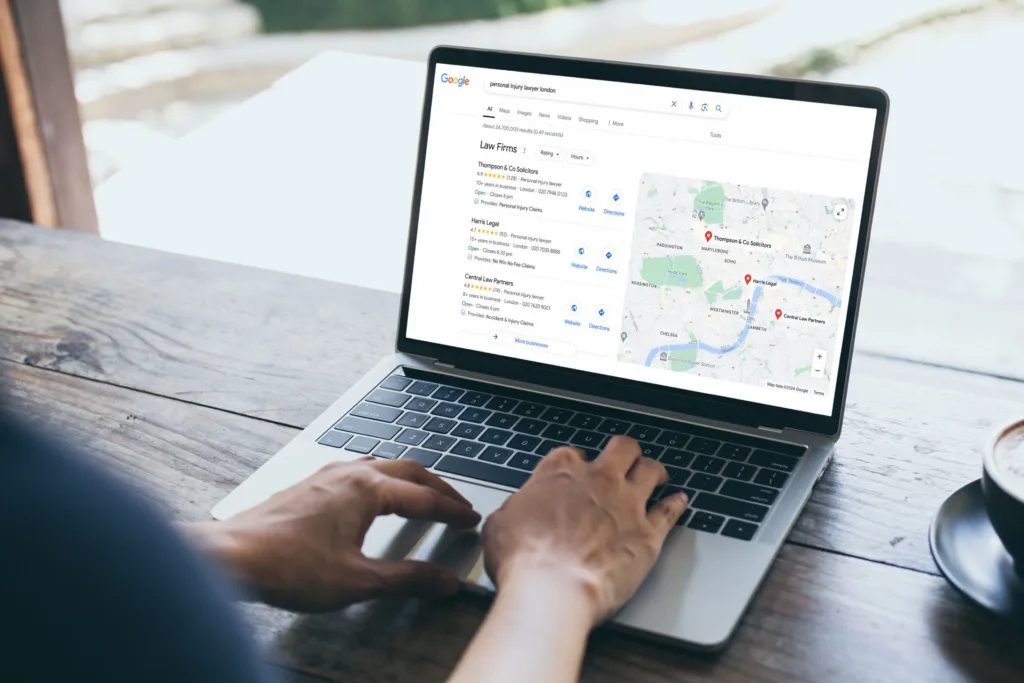
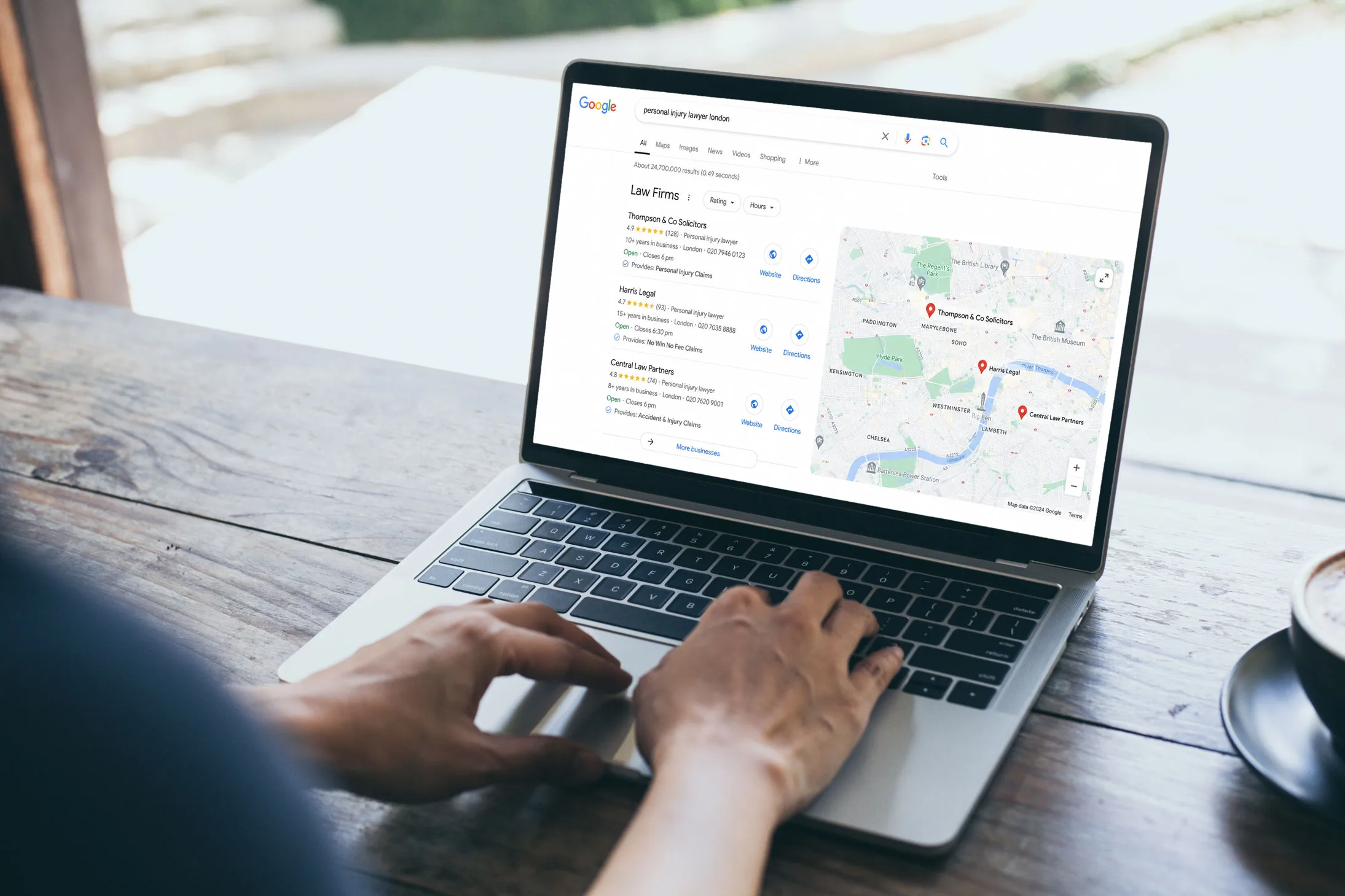
Local SEO helps your law firm appear in Google when someone searches for legal services in your area. It focuses on improving your visibility in:
- The Google Map Pack (the three featured local results)
- Localised organic search results
- Your Google Business Profile (GBP)
- Local directories and citation sites
When someone types “family solicitor near me” or “conveyancing solicitor in Leeds”, Google uses local signals to determine which firms appear first. Local SEO is the method we use to strengthen these signals to help your firm stand out from the local crowd.
Why Does Local SEO for Law Firms Matter?
Local SEO helps law firms appear when clients search for solicitors in their area. Most people look for nearby legal help, so improving your visibility in local results and in the Google Map Pack is essential for winning more enquiries.
Clients Want Nearby Solicitors
Even with more legal services moving online, many clients still prefer a local firm they can visit in person and to have the opportunity to meet with their solicitor face-to-face, especially for sensitive matters like family law and wills and probate. Ranking well locally helps builds trust and increases enquiries.
The Map Pack Gets the Most Attention
Studies suggest the Local Map Pack receives around 40–50% of clicks for local intent searches so appearing here naturally gives your firm a strong advantage.
High Intent, Low Waste
Local SEO targets people who are actively seeking local legal help. This means fewer wasted clicks and more qualified enquiries.
How to Improve Your Law Firm’s Local SEO
1. Optimise Your Google Business Profile
Your Google Business Profile (GBP) is the foundation of local SEO. A well-optimised profile makes you more likely to appear in the Map Pack.
Make sure you:
- Use your exact firm name
- Choose accurate categories (e.g. “Family Law Solicitor” or “Conveyancer”)
- Add photos of your office and people
- Keep opening hours updated
- Add clear and concise service descriptions
- Post updates and news regularly
Top Tip: Google Reviews Matter. Client reviews strongly influence local rankings so be sure to ask your clients for feedback at natural points in your process and be sure to respond to all reviews (both good and bad) in a professional manner.
2. Use Local Keywords on Your Website
Being a local law firm is great for high-street presence and visibility, but for online visibility you need to use local keywords sympathetically and effectively in your content to have a chance of being seen online.
Each service page should clearly target:
- The legal service you are offering
- Your location(s)
Sometimes you might have multiple locations so you can either accommodate all locations on the single service page or, you might choose to build a dedicated page for each unique location.
For example:
- “Family Solicitor in Doncaster”
- “Conveyancing Solicitors in Sheffield”
- “Wills and Probate Lawyer Leeds”
You should look to include these terms naturally in your headings, intro lines and in your FAQs.
Top Tip: Include a clear Call to Action (CTA). It’s a good idea also to include a clear call to action (CTA), such as “Contact our Family Law Solicitors in Leeds” which offers an additional, and natural, opportunity to include your location based keywords.
3. Create Clear Location Pages
We’ve made sure that your service pages include relevant location based keywords, and some of these keywords should link to a supporting and dedicated location page. If you serve multiple towns or areas you should create a dedicated page for each location.
The primary purpose of these location pages is to let the visitor know exactly where your office is located and they should include a map, clear directions and instructions, and the necessary contact details such as your address, phone number, and email address.
For example, if you have an office in Sheffield, Doncaster, and Leeds, you should have a dedicated page for each office that focusses solely on that location. These pages help Google understand where you operate and allow your firm to rank in more than one area.
Top Tip: Include your location in your Slug. Your slug is the text in your website address that appears after your domain. It is just on more window of opportunity to include your location. For example, the website address (also known as the URL) www.AmazingLawFirm.co.uk/Solicitors-In-Birmingham has the slug Solicitors-In-Birmingham.

What is Query Fan-Out? A Simple SEO Guide for Law Firms
If your law firm blogs or service pages aren’t getting the traffic you hoped for, the issue might not be your writing, it could be how narrowly focused your content is. “Query Fan-Out” is a simple Law Firm SEO method that helps you expand your topic to cover related searches.
Find out how to implement Query Fan-Out by reading Rich‘s recent blog.
4. Build High Quality Local Citations
Citations are listings of your firm’s name, address and phone number (NAP) on trusted websites. Consistent citations help Google trust your business details.
Important sites for solicitors include:
- Law Society “Find a Solicitor”
- Yell
- Thomson Local
- Local business directories
- Chambers of Commerce
Ensure your details match exactly across all platforms. In addition to your NAP, be sure to include a brief explanation of the services you offer. Remember you are trying to increase visibility for your firm for local searches, so including keywords such as “Family Law”, or “Divorce”, or “Probate” in your listing along with your NAP will increase your chances of being surfaced for searches such as “Divorce Solicitor Leeds”, for example.
Top Tip: Schedule a regular review of your local citations. Because you don’t own or control the directories, you are at the mercy of their actions so a regular review of your listing is important to ensure that your NAP and any other relevant details remain correct. Remember that consistency is key, so all of your listings must match exactly.
5. Produce Useful Local Content
Content that mentions your locality helps you build authority in your area. It doesn’t need to be complex — it just needs to be relevant. Simply, by adding your contact details at the foot of your page, you can incorporate powerful location based keywords. For example, you might end your content with “Contact our Divorce Solicitors in Leeds on 01234 567890” and hey presto, you have included the important and powerful keywords “Divorce Solicitors” and “Leeds” which together will serve local based searches such as “Divorce Solicitor Leeds”.
According to Semrush data (Dec’25) the search term “Divorce Solicitors Leeds” garners some 260 searches per month!
Producing local content doesn’t stop at simply including your location at the foot of any page, although it’s a good place to start!
Produce a dedicated page that focusses on a specific location. For example an article on “How Conveyancing Works in Doncaster” offers you the opportunity to naturally include your location throughout your page for a given service which really boosts your visibility for searches that include the keywords “conveyancing” and “Doncaster”.
This type of content shows Google (and clients) that your firm understands local legal issues, provides popular and in-demand services locally, and, as is a common desire for consumers, you are a local firm whom the clients can visit in person.
Top Tip: Don’t be lazy by simply duplicating your page with different location keywords. You might be tempted to duplicate a page and simply replace all location words with a different location – don’t do that! The purpose of a page is to be useful to the User, not a doorway page to useful content. Duplicate content can cause many issues but worst of all duplicate content that offers little to no value other than it being a portal page to other useful content can result in your page being downgraded by Google. So, make your content useful and unique while incorporating those powerful location based keywords.
6. Strengthen Local Authority with Backlinks
Backlinks remain one of Google’s strongest ranking signals. For local SEO, it’s not just about the number of links you earn, but the relevance and trustworthiness of the websites linking to your law firm. Building genuine connections within your local community can improve both your search visibility and your reputation.
Focus on earning backlinks from:
- Local news websites
- Sponsorships (sports clubs, charities and community events)
- Community organisations
- Schools, colleges or universities you’ve worked with
- Local charities and not-for-profit organisations
- Local business networks and Chambers of Commerce
These links demonstrate that your firm is an established and trusted part of the local community, helping Google understand your geographic relevance while also increasing referral traffic from people in your area.
Top Tip: Prioritise quality over quantity. Don’t chase hundreds of backlinks. Instead, focus on earning high-value backlinks that genuinely reflect your firm’s local presence. A single backlink from a respected local organisation or news website can often have a greater impact than dozens of low-value, irrelevant links. Think of backlinks as recommendations: Google values endorsements from trusted, locally relevant sources far more than sheer volume.
7. Make Your Website Locally Relevant
Your website should clearly demonstrate where your law firm is based and the areas you serve. While Google uses many signals to determine local relevance, providing consistent location information across your website helps search engines and potential clients understand that you genuinely operate in the locations you’re targeting.
On your main pages, include:
- Your full office address
- A local telephone number
- A Google Map embed
- Clear contact details
- References to the towns, cities or regions you serve where appropriate
These local signals help Google associate your website with specific geographic areas, making it easier for your firm to appear in relevant local search results.
Top Tip: Don’t hide your location information on your Contact page alone. Where appropriate, include your office location and the areas you serve naturally throughout your website, particularly on key service and location pages. This reinforces your local relevance for both Google and prospective clients without resorting to keyword stuffing.
A Quick Local SEO Checklist for Solicitors
To help you keep track of the critical elements you should look out for and focus on, you can use the below quick local SEO for law firms checklist. Use this checklist to periodically check your local SEO credentials and to ensure your information is always correct and up to date.
Is your Google Business Profile up to date?
- Is it complete and up to date?
- Does it include clear and current photos?
- Are your services accurate and up to date?
- Is it up to date with reviews and your replies?
- Are your opening hours correct?
Is your Website up to date?
- Do you have localised service pages?
- Do you have dedicated location pages?
- Are your local keywords used naturally throughout?
- Is your address and contact details visible, clear, and correct?
- Do you have adequate and functional internal links between related pages?
Have your optimised for Authority?
- Do you have consistent local citations?
- Do you have local content?
- Do you have local backlinks and are they still working as expected?
- Do you have a good review profile?
Why you should use an SEO specialist to boost your Local Law Firm SEO
Local SEO for Law Firms is one of the most effective ways to generate new instructions based on local demand for local professional services. By optimising your Google Business Profile, creating strong local pages and building your presence in local directories and communities, you can significantly increase your visibility.
With support from Rich at Accesspoint, law firms can build a practical and sustainable local SEO strategy that attracts more clients and strengthens their reputation within the areas they serve.

Contact our Law Firm SEO Expert
If you want to chat about local SEO for law firms or you want to discuss your law firm SEO and how Accesspoint can help, then email me today. And don’t forget to check out our client case studies below!